Here is the Volume 1 of Equestrian from When you watch something, visit us first! Mr. Shigeyuki HOSONO, President of #HachiojiRidingClub, told us about 6 disciplines of Equestrian this time. This is the combined version of Part 1-1 through 1-3 on our YouTube channel.
At Paris Olympics, Japan’s national Equestrian team won a medal for the first time in 92 years.
This time, we interviewed Mr. Shigeyuki HOSONO, President of Hachioji Riding Club, who competed as Japan’s national Equestrian team at Atlanta (1996) and Sydney (2000) Olympics, and served as Team Manager for Rio de Janeiro (2016) and Tokyo (2021) Olympics, about the appeal of Equestrian.
Please use this information when watching Equestrian events.
.png)
Part 1-1: 6 disciplines of Equestrian
Equestrian are categorized into six disciplines as competitive events.
The most well-known is probably “Jumping.” This is the discipline where Riders and Horses jump over obstacles inside the stadium and clear round with no penalty. Dressage, unlike Jumping, does not involve jumping over obstacles. Rather, it is a discipline that competes for beauty and elegance. It involves performing prescribed movements flawlessly while also competing for artistic expression and beauty.
And then there is Eventing. As you may know, this is the event where Japan’s national team won a bronze medal at Paris Olympics. It combines, like Nordic combined Ski, Dressage and Jumping events, which I mentioned earlier, and Cross Country event, where Riders navigate natural terrain and obstacles. Eventing is decided by the total scores from these three disciplines.
These are the three disciplines held at Olympics, but there are also some disciplines, for example one called “Vaulting,” which is like “gymnastics performed on horseback.” Trying handstands or letting go for a handstand—there are all sorts of tricks. That kind of discipline exists too.
And besides that, another discipline is “Driving.” Riders are required to control Horses while driving the carriage. There are also Driving where Riders race among obstacles.
And the last discipline is Endurance. This is like a car rally, and instead of jumping over obstacles, it involves covering long distances, around 160 km in World Championships, with one Horse and one Rider. Along the course, there are crews to care for Horse’s health at checkpoints. This is Endurance.
There are such six disciplines. Regarding these six disciplines, they are held at World Championships of Equestrian.
Part 1-2: 3 disciplines in Olympics
Jumping
Q: We can see Jumping relatively often, but what kind of discipline is it?
Well, to put it simply, there are obstacles installed inside the stadium. These are essentially bars. Most of them are composed with wooden bars. Dropping these bars will result in a 4-point deduction. And if Horse dislikes this obstacle and refuses to jump over it, that will also incur a 4-point deduction. Two refusals result in elimination. They cannot proceed any further.
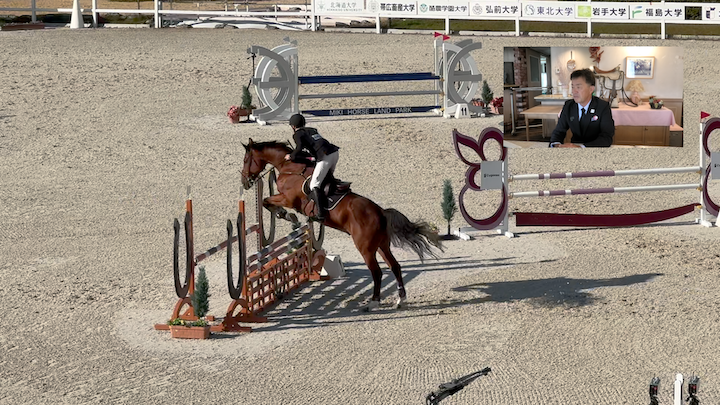
These are the rules. So the winner is the Horse and Rider who finish with the fastest time without touching any bars. It is a bit simple, but these are the rules of Jumping.
Dressage
Q: You mentioned that Dressage is about competing for beauty and elegance, but what aspects are judged?
Yes. Horse’s movements in Dressage can be basically categorized into three types: walk, trot, and canter. Among those three movements, sometimes Riders instruct Horses to walk extremely slowly or extending the stride length.
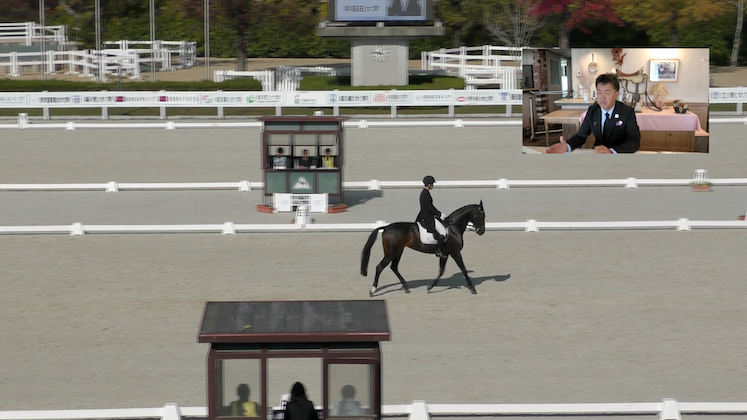
Also, the accuracy of the figures drawn by Horse. That ultimately comes down to how accurately the instruction of Riders are being conveyed to Horse. These aspects are judged in Compulsory performance.
Also, of course, the elegance and the grandeur of movement. And, there are also Free performance, where to perform with music, but judges score them based on artistic harmony and such elements. This is Dressage.
Q: Then, a high level of coordination between Rider and Horse is required in Dressage?
That’s right. As you say, it is a judged sport, so captivating the audience is essential, but to achieve that, it requires the “unity of Rider and Horse.”
On Dressage, considering an excellent performance, it is when Horse appears to be dancing on its own, i.e., when Horse seems comfortable and genuinely enjoying the performance. This aspect also carries significant weight in scoring. That represents the “pinnacle of the unity between Rider and Horse.”
Q: So in Dressage, is it preferable for Rider’s instructions to be less noticeable?
Yes. Skilled Riders are those who can give instructions so subtly. On the other hand, less skilled Riders, like beginners, tend to make their instructions very exaggerated movements. Then, this can losing their balance, preventing Horse from receiving the correct instruction, which leads to deductions. We can see that happens.
Eventing
Q: So Eventing combines Jumping, Dressage, and Cross Country, right?
Correct. Generally, Dressage is held on the first day. And for longer courses, Cross Country is on the second day and Jumping on the third. However, for shorter courses, Cross Country may be held last, with Jumping as the second event.
Part 1-3: 3 additional disciplines in World Championship
Vaulting
(Sample video= https://www.clipmyhorse.tv/en_EU/academy/lesson/1cd7ec5b605bdbae24589d7f4d5ea220)
Q: Since we have not seen “Vaulting” very often, but what kind of discipline is it?
Vaulting involves a postilion. Someone not riding Horse attaches a rope to Horse, guiding it to move in a circle at a steady pace. Horse is connected to the postilion. In that situation, there are some Riders, and they take turns jumping onto Horse, standing on it without gripping, doing handstands, spinning around, and so on.

I think we cannot see it very often in Japan, but even here, some youth Riding Clubs do Vaulting as this is like gymnastics. Small, flexible children practice and then perform Vaulting. There are such youth Clubs.
Those who compete in World Championships are truly like gymnasts performing gymnastics on a horse—Vaulting is the kind of sport.
Q: Jumping onto Horse seems to cause it stress, doesn’t it?
Well, even when you say “jump onto Horse,” doing so without startling Horse is also a skill in itself. If Horse’s movements get disrupted, it affects the next part of the performance, so quietly jumping without startling Horse—that is a technique. I think it is quite a skill.
Driving
(Sample video= https://www.clipmyhorse.tv/de_DE/ondemand/event/15516/competition/398730?start_at=15570037)
Q: Though they cannot jump over obstacles in Driving competition, what do they compete in?
Yes. Next is Driving. Driving use, for example, four-horse carriages. Controlling four Horses at once requires considerable skill, and since Driving requires many Horses, it’s considered one of the most expensive Equestrian disciplines.
Furthermore, the carriages themselves—though they do not have engines—apparently cost about the same as luxury foreign cars, making it the most costly Equestrian discipline. It costs certainly very expensive.
Q: So does that mean Driving combines several different events into one competition?
Yes. It does not jump over obstacles, but it does things like slalom runs or turning at designated points. It accelerates or decelerates, for example. In Driving, like Eventing, they incorporate elements like beauty and accuracy as well as navigating rough terrain. These aspects are blended into Driving.
What they are doing at World Championships currently for Driving discipline, just like in Eventing, is probably judging whether Riders are accurately navigating each point, or racing over rough terrain and competing on that. Also, there are balls placed inside the stadium, and Riders have to avoid hitting them with their tires or knocking them down. It is not exactly an obstacle race. But it is a competition that combines elements like that.
Endurance
Q: What kind of sport is Endurance?
Endurance truly involves covering very long distances while carefully monitoring Horse’s health. It is quite popular in desert regions, with many Middle Eastern countries investing significant effort in it. In Europe too, like France, Endurance has considerable popularity in mountainous areas.
Q: How long distance do Riders and Horses have to cover in Endurance?
Well, for example, at World Championships, it is about how quickly Riders and Horses can cover 160km distance. But if they just push Horses relentlessly, they will get exhausted. And there are veterinary inspections at various checkpoints along the course. How well Horses can cover the course in a healthy condition until the very end. It is a discipline where faster completion times lead to higher rankings under such situation.
Q: How long does it take to cover such 160 km?
I think it probably takes about whole day to cover. So there are many crews taking care of Horses, providing care just like in a car rally. At each checkpoint, they cool Horses down and taking care of their bodies. Endurance competitions, where such crews accompany Horses throughout the race, really resemble car rally.
Share this content:
コメントを残す